
St. Augustine’s Abbey ruins are easy to overlook. Located just outside the medieval city wall, the abbey is quieter and far less photographed. Built around the year 598, it was once one of the most influential abbeys in medieval Europe. Now, the ruins are only shadows of what once stood. They don’t tower into the sky like other abbey ruins throughout Britain, but there’s a whisper of the past among the stone remains — an invitation to wander the grounds and imagine what once was. In that way, they remain a powerful beacon from centuries before.
A Brief History Written in Stone
Although the exact founding date remains somewhat uncertain, St. Augustine’s Abbey was established around 598 AD, making it one of the earliest Christian sites in England. For hundreds of years, it served as a monastery, a royal burial ground, and a center for learning. But when Henry VIII dissolved the monasteries, the abbey fell into ruin. Many of its stones were repurposed for other buildings, its cloisters emptied, and its chapter house fell forever silent.
These are the broad strokes of its history — the bullet‑point version — but countless lives were lived in and around the abbey.
An Impressive Queen
In the abbey’s earliest days, Queen Bertha — a devoted Christian and Frankish princess — married King Æthelberht of Kent. As a pagan, he did not share her beliefs, but he agreed to allow her to practice her faith as part of their marriage agreement. When St. Augustine was sent by Rome to Canterbury, it was Bertha who persuaded her husband to listen. With her influence, and under the guidance of the Pope and Augustine, Æthelberht eventually converted to Christianity.
Considering the culture and beliefs of the time — and the limited roles afforded to women —most records from the period barely mention her. Women were often considered inconsequential beside the men who dominated political and religious life. Yet the Pope compared her to Helena, mother of Constantine, the first Christian emperor of Rome. It’s difficult to imagine a greater compliment paid to any woman of her era.
She must have been a formidable woman, and it’s easy to imagine Queen Bertha walking the early halls of the abbey, her presence quietly shaping the future of English Christianity.
A Revered Stone
Before St. Augustine arrived in Canterbury, local tradition tells of a stone on the Isle of Thanet where St. Augustine first landed. The story goes that when he stepped onto the shore, he left a permanent indent in the rock. The stone was later moved to a chapel, and an annual pilgrimage began during which locals prayed for healing at its base.
Daily Life Within St. Augustine’s Abbey
For all its political and religious significance, St. Augustine’s Abbey was, at its heart, a home where dozens of monks lived quiet, disciplined lives shaped by devotion, routine, and the slow, steady work of preserving knowledge.
Life began long before sunrise. The monks rose in the dark, gathering in the church for Matins, their voices rising in soft chant that echoed through the stone arches. Prayer framed every part of their day — the thread that held their lives together. After Matins came Lauds, then a simple breakfast of bread and ale.
From there, the abbey shifted into motion. Some monks tended the gardens, growing herbs for medicine or vegetables for meals. Others cared for the sick in the infirmary, mixing salves and tinctures from plants grown just outside the cloister. A few taught novices, passing on traditions that had shaped the abbey since its founding. But the heart of intellectual life was the scriptorium — a long, quiet room where monks copied manuscripts by hand.
Silence was expected and cultivated. Meals were eaten in the refectory without conversation, accompanied only by the voice of a reader reciting scripture. But despite the silence, the abbey was not a lonely place. It was a community bound by the shared experience and belief in prayer, learning, service. They cared for travelers, offered charity to the poor, and maintained the rhythms of worship that shaped Canterbury’s spiritual life.
A Notorious King and A Stop for a Future Queen
Hundreds of years later, St. Augustine’s important collided with political posturing when Henry VIII ordered his men to dismantle St. Augustine’s Abbey with brutal efficiency. The Dissolution of the Monstaries had already taken place in other areas of Britain, and tales of the sometimes brutal conflicts, the monks at St. Augustine chose to peacefully surrender. The site was systematically stripped of its treasures and wealth, including fragments from St. Augustine’s skull. Tombs and shrines were destroyed, and by the time the king’s men moved on, very little remained of the once‑majestic abbey.
Only the abbey apartments were spared and were converted into a royal palace. In 1539, Henry VIII ordered the palace be readied for his next queen, Anne of Cleves. She was greeted by the Archbishop of Canterbury on December 29, 1539 and stayed one night in the palace before making her way to meet the infamous king.
The Lost Library
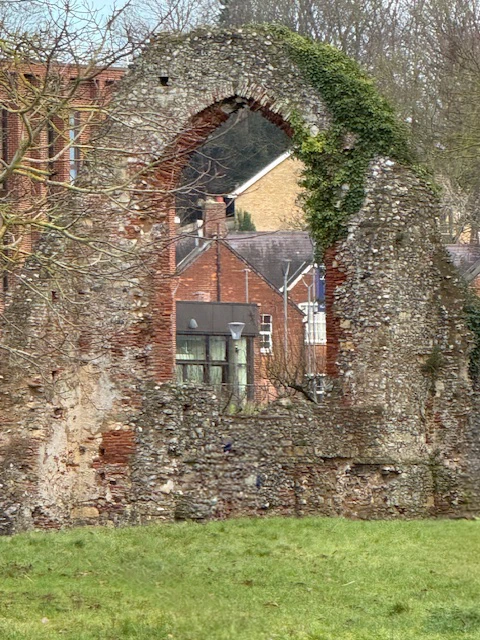
Among the most heartbreaking losses tied to St. Augustine’s Abbey is its library, which was once considered one of the most important centers for learning in medieval England. Before universities existed and Canterbury cemented its importance as a city of pilgrimage, the abbey’s library served as a beacon of knowledge. Monks spent hours in the scriptorium, bent over parchment, copying manuscripts by hand. Some worked by daylight; others continued by candlelight, their ink freezing in winter, their fingers stiff from the cold.
The library held biblical texts, classical works, early English histories, and countless manuscripts that recorded the growth of Christianity in Britain. It was a place where learning was both preserved and created.
When Henry VIII ordered the Dissolution of the Monasteries, the library was one of the first casualties. Books were ripped from their bindings, manuscripts burned or scattered, and centuries of knowledge vanished almost overnight. Only 283 volumes survived, those writings now held in museums and archives far from the abbey that once protected them.
Standing among the ruins today, it’s impossible not to imagine the library as it once was: shelves lined with manuscripts, the smell of ink and vellum, the quiet scratch of quills across parchment. The silence of the ruins feels heavier when you remember that this was once a place where knowledge lived, breathed, and grew.
Walking the Ruins Today
Walking through St. Augustine’s Abbey feels different from visiting the Cathedral. The Cathedral rises above the city with confidence and grandeur, but the abbey sits quietly, its presence softer, its story carried in fragments. The grass grows thick over the old foundations, softening the outlines of the church and cloisters. The sky fills the empty spaces where stone once rose, and the wind moves through the broken walls like a voice that remembers more than it can say.
Footsteps sound different here — slower, quieter, as if the ground itself encourages you to take your time. You can stand where the monks once walked their cloister, the worn stone now open to the weather. You can trace the edges of the chapter house, imagining the echo of voices that once gathered in debate or prayer.
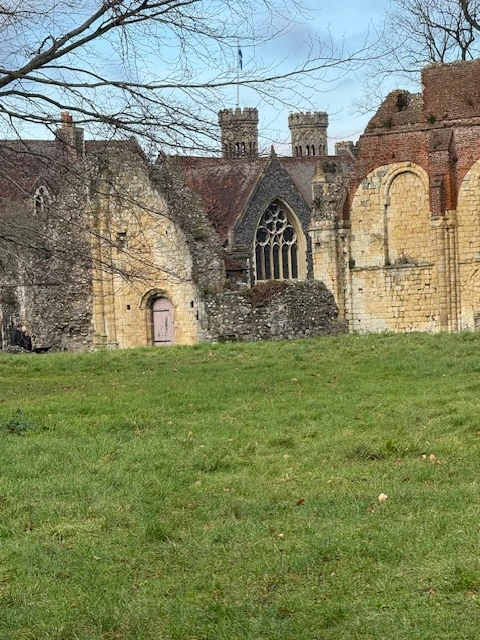
There’s a moment, usually when the sun hits the stone just right, when the ruins feel less like remnants and more like a doorway — a place where the past doesn’t feel distant at all. Read More
Learn more about what it's like first Stepping Into Canterbury — Where the Story Has Already Begun.
But long before the abbey was built, the Romans lived in what would be one day become Canterbury. A rich townhome is not far from the abbey; explore its halls here.
At the start of your bookish travel planning? Read my full guide here.
Stay a Little Longer
Quiet stories, warm places, and new paths to wander — delivered gently to your inbox.
Join the Journey